

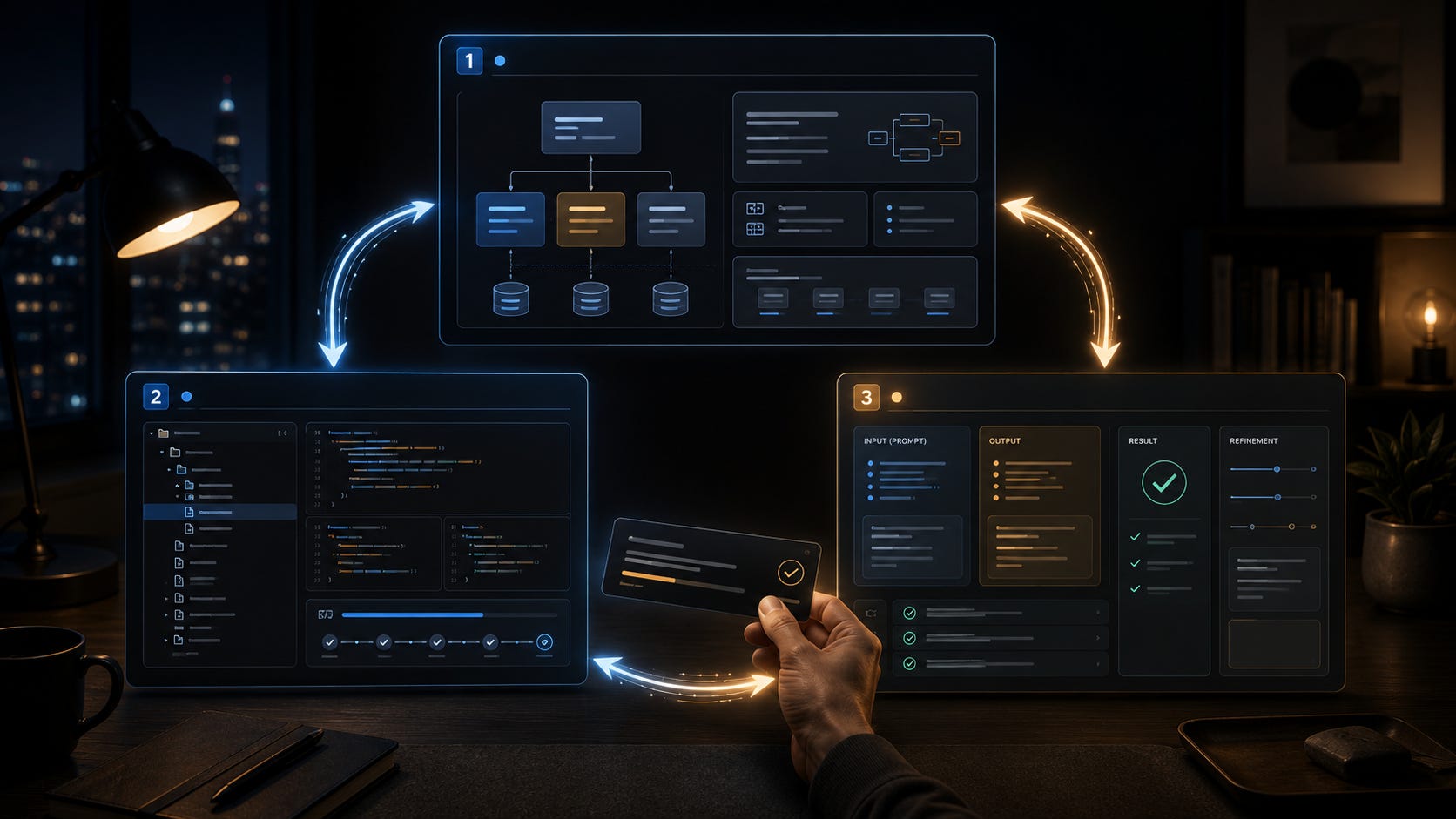
My AI-Assisted Software Development Workflow
A Unique Approach to Building with AI?
Here’s my process when I build. You can call it “vibe coding,” but I prefer “assisted software development.” And, I don’t know if my approach is unique, but the more I’m online and on LinkedIn, and the more I see people complaining about AI—how hard it is to use, how “non-intelligent” it is, or how it overcomplicates things—the more I think that the way I work might be a little different than most as I just don’t struggle with the same issue others do.
One of the main things I do is use multiple versions of the same LLM for different parts of the workflow.
Here’s what I mean:
Phase 1: System Design and Architecture
When I’m building an application, I typically start by designing it in a regular Claude chat (the web browser version). For this stage, I use a model like Sonnet 4.6 (but now Sonnet 5; things change quickly in the realm of AI), which is excellent conversationally and intelligent enough to help me build and design my systems without burning through my token usage. Model distinction is important because you don’t need a token-heavy model like Opus 4.8 (and now the newly reinstated Fable 5) just to build out an implementation plan. Sonnet 4.6 is good enough to flag issues and create a high-level execution plan, and then I
